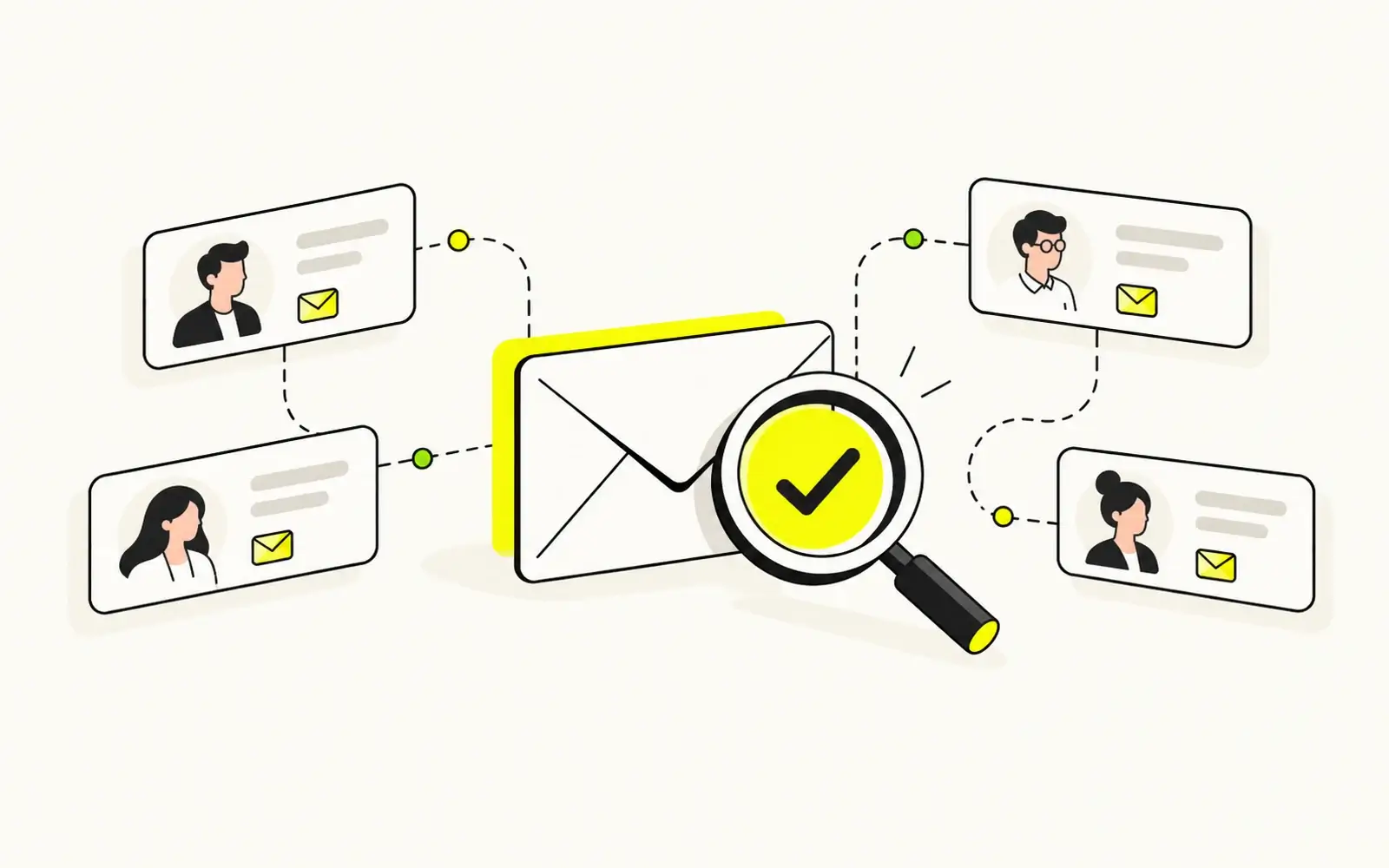
“Why traditional SMTP verification struggles with catch-all domains—and how Kitmind AI-powered verification helps B2B teams make better decisions?”
Introduction
Catch-all email verification is one of the biggest unresolved challenges in B2B email prospecting. Industry estimates suggest that approximately 36–40% of business email addresses are associated with catch-all domains. This means a significant share of potentially valuable B2B contacts may be difficult to verify using conventional SMTP-based methods, creating a major challenge for businesses seeking reliable email data and broader prospecting coverage.
Traditional email verification tools rely heavily on SMTP responses to determine whether an address is valid. But catch-all mail servers can accept messages addressed to both existing and nonexistent mailboxes without revealing which addresses are real.
The result is a frustrating problem for sales, marketing, and go-to-market teams: potentially legitimate contacts are frequently classified as Risky or Unknown.
Sending to these addresses without additional verification may increase bounce risk. Excluding them entirely can mean losing access to decision-makers and potential customers.
Kitmind approaches this problem differently!
Kitmind's AI-powered email verification system goes beyond conventional SMTP checks to verify business email addresses, including catch-all emails and addresses that traditional verification tools classify as Unknown. According to Kitmind's internal performance data, its AI verification technology achieves approximately 99% coverage of catch-all cases, with over 98% verification accuracy.
These figures describe different measures of performance, not guaranteed inbox delivery.
In this guide, we'll explain what catch-all emails are, why traditional verification struggles with them, and how Kitmind AI verifies business email addresses—including catch-all and traditionally Unknown emails—to help teams discover verified B2B contacts.
What Is a Catch-all Email?
A catch-all email is an email address associated with a domain configured to accept messages for multiple recipient addresses, even when the receiving server does not confirm whether each individual mailbox exists.
A catch-all domain may accept mail sent to addresses such as:
john@company.comsales@company.comunknown123@company.com
Even if only some of those mailboxes are real, the mail server may initially accept all three messages.
This creates an important distinction:
An email server accepting a recipient does not necessarily mean the recipient's mailbox exists.
For a conventional email domain, a server may reject an address that does not exist. For a catch-all domain, the server may accept the recipient during the SMTP conversation and decide what to do with the message later.
That makes recipient-level verification much harder.
What Is a Catch-all Domain?
A catch-all domain is a domain whose email configuration can accept messages addressed to recipients that are not explicitly recognized during the initial SMTP exchange.
Depending on the organization's mail infrastructure, accepted messages may be routed to a designated mailbox, filtered, quarantined, discarded, or rejected at a later stage.
Not every server that accepts an unknown recipient is necessarily configured with a traditional catch-all mailbox. Some servers deliberately hide recipient information to prevent address harvesting.
However, both situations can produce a similar challenge for external email verification services: the server does not provide enough information to confirm an individual mailbox.
Does Catch-all Mean an Email Address Is Valid?
No.
A catch-all response indicates how the receiving mail infrastructure handles a recipient during verification. It does not prove that the person, mailbox, or address exists.
For example, ceo@company.com might be a genuine executive mailbox, while random123@company.com might not belong to anyone.
If the server accepts both recipients, an SMTP-only verification tool may be unable to distinguish them.
This uncertainty is the fundamental catch-all verification problem.
How Do Catch-all Email Servers Work?
To understand why catch-all email verification is difficult, it helps to compare two different mail-server behaviors.
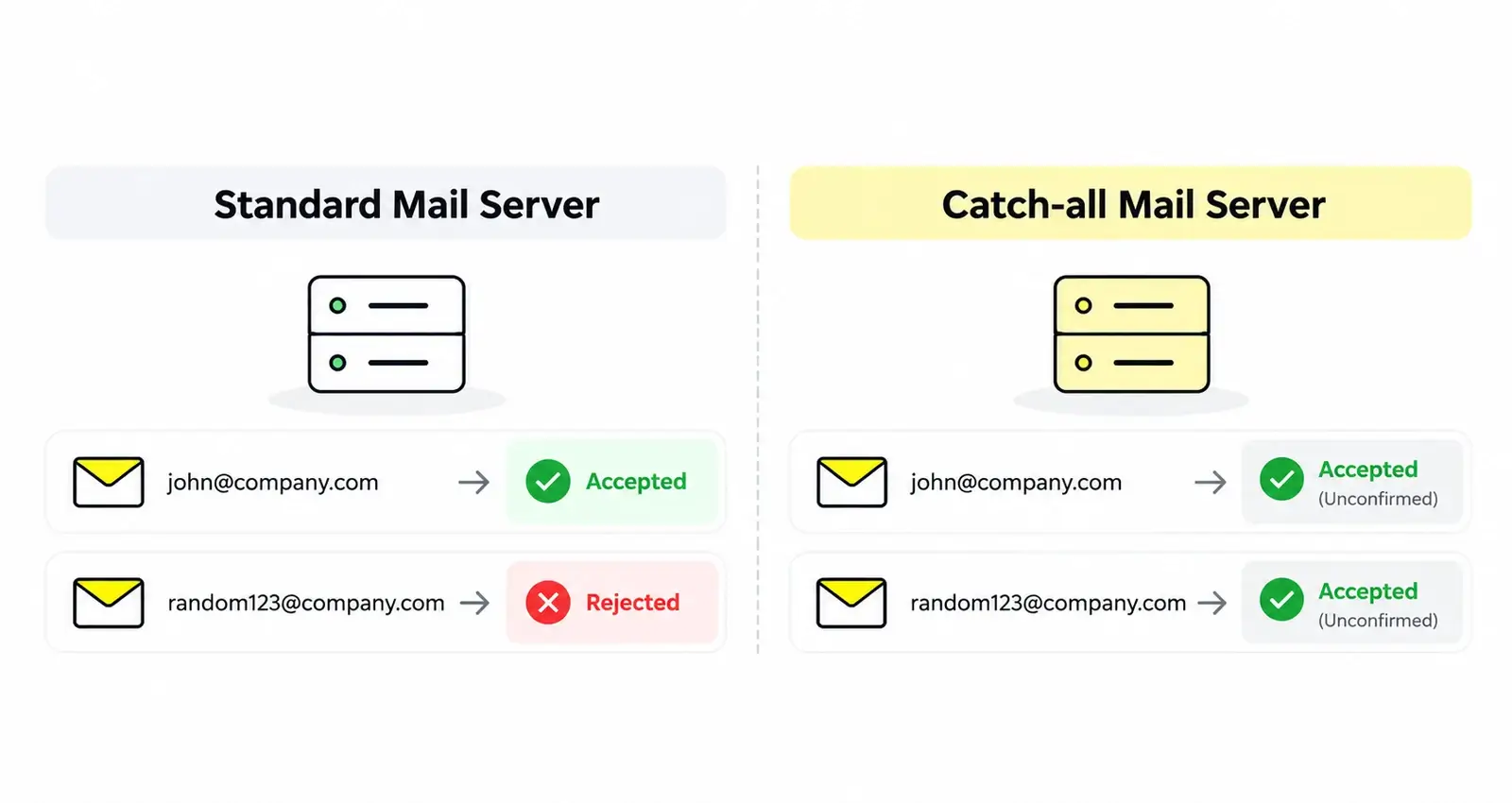
Standard Email Servers
When a verification service checks an email address, it may communicate with the recipient domain's mail server using SMTP.
During this process, the server can respond differently depending on whether the recipient is recognized.
For example:
- Existing mailbox:
john@company.com→ Recipient accepted - Nonexistent mailbox:
random123@company.com→ Recipient rejected
When the server provides meaningful recipient-level responses, verification services can use that information to help classify email addresses.
However, not every server exposes this information.
Catch-all Email Servers
A catch-all server may accept both addresses:
- Existing mailbox:
john@company.com→ Recipient accepted - Nonexistent mailbox:
random123@company.com→ Recipient accepted
From the outside, these responses may look identical.
The verification service knows that the server accepted the SMTP recipient, but it cannot confidently determine whether a real mailbox exists behind the address.
This is why catch-all domains often produce inconclusive verification results.
Why Do Companies Use Catch-all Configurations?
Organizations may use catch-all configurations or recipient-obscuring mail policies for several reasons.
- Message handling: Some businesses want to capture messages sent to misspelled, outdated, or unrecognized addresses.
- Privacy: Organizations may avoid revealing which employees have active mailboxes.
- Security: Recipient-obscuring responses can make automated mailbox enumeration more difficult.
- Centralized routing: Some mail systems route unmatched messages through shared processing or filtering infrastructure.
These configurations are not inherently suspicious. Many legitimate organizations use mail-server policies that make external mailbox verification difficult.
The challenge lies in distinguishing genuine business contacts from addresses that only appear acceptable at the server level.
Why Traditional SMTP Verification Struggles with Catch-all Emails
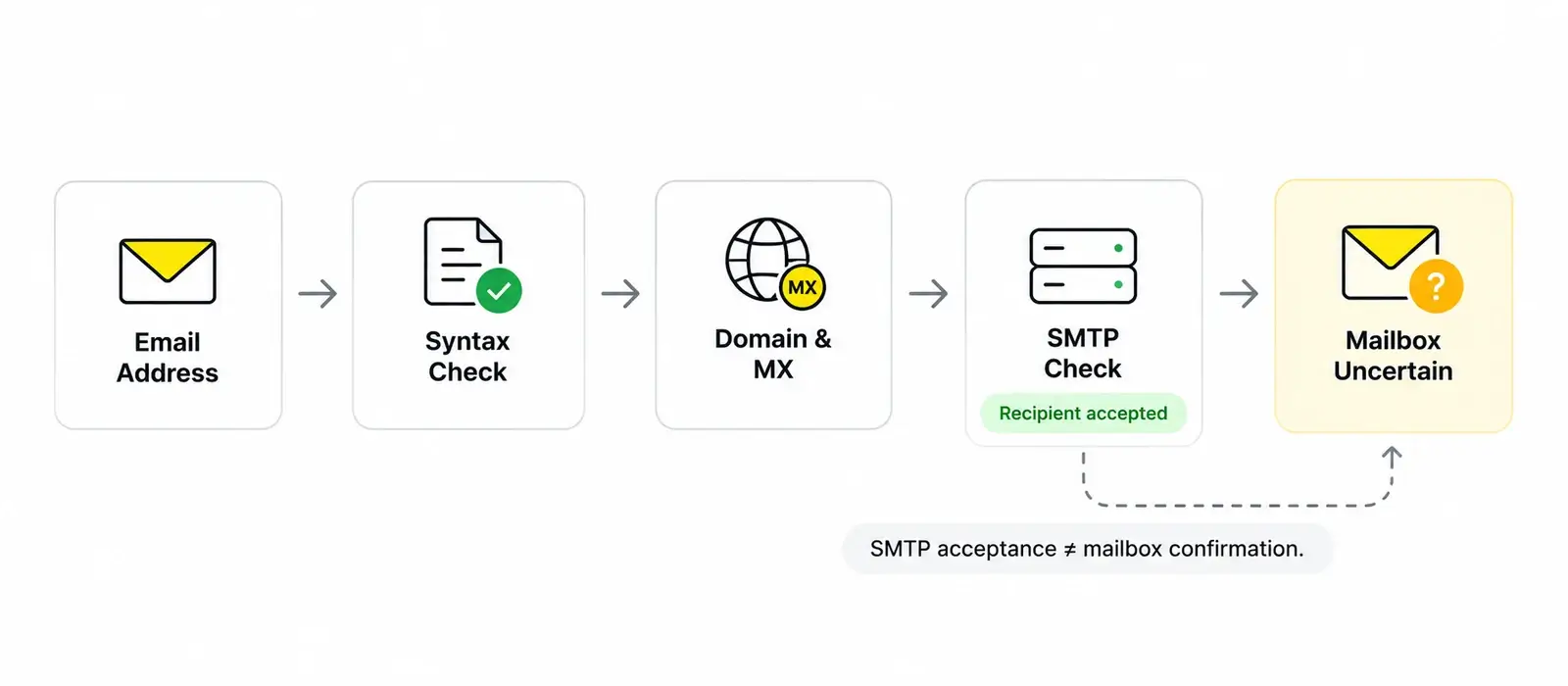
Traditional email verification combines several technical checks to assess whether an email address is likely to receive messages.
These checks are useful, but they have limitations.
How Standard Email Verification Works
A typical verification process includes the following stages.
- Syntax validation
The system checks whether an email address follows a valid format. - Domain validation
The system checks whether the domain exists and whether relevant DNS information is available. - Mail-server checks
The verifier examines MX records or other applicable mail-routing information to determine how the domain receives email. - SMTP evaluation
Where supported, the system communicates with the receiving server to evaluate how it responds to a recipient address. - Risk verification
The system combines available signals and assigns a verification status.
These steps can identify many malformed, nonexistent, or otherwise problematic addresses.
But they do not guarantee that every mailbox can be verified.
Where SMTP Verification Reaches Its Limit
The central limitation appears when a mail server accepts a recipient without confirming mailbox existence.
A traditional verification service may receive a positive SMTP response for an address that does not correspond to a real inbox.
Other servers may temporarily reject requests, limit verification attempts, or conceal recipient-level information.
In these situations, SMTP verification alone cannot establish a reliable conclusion.
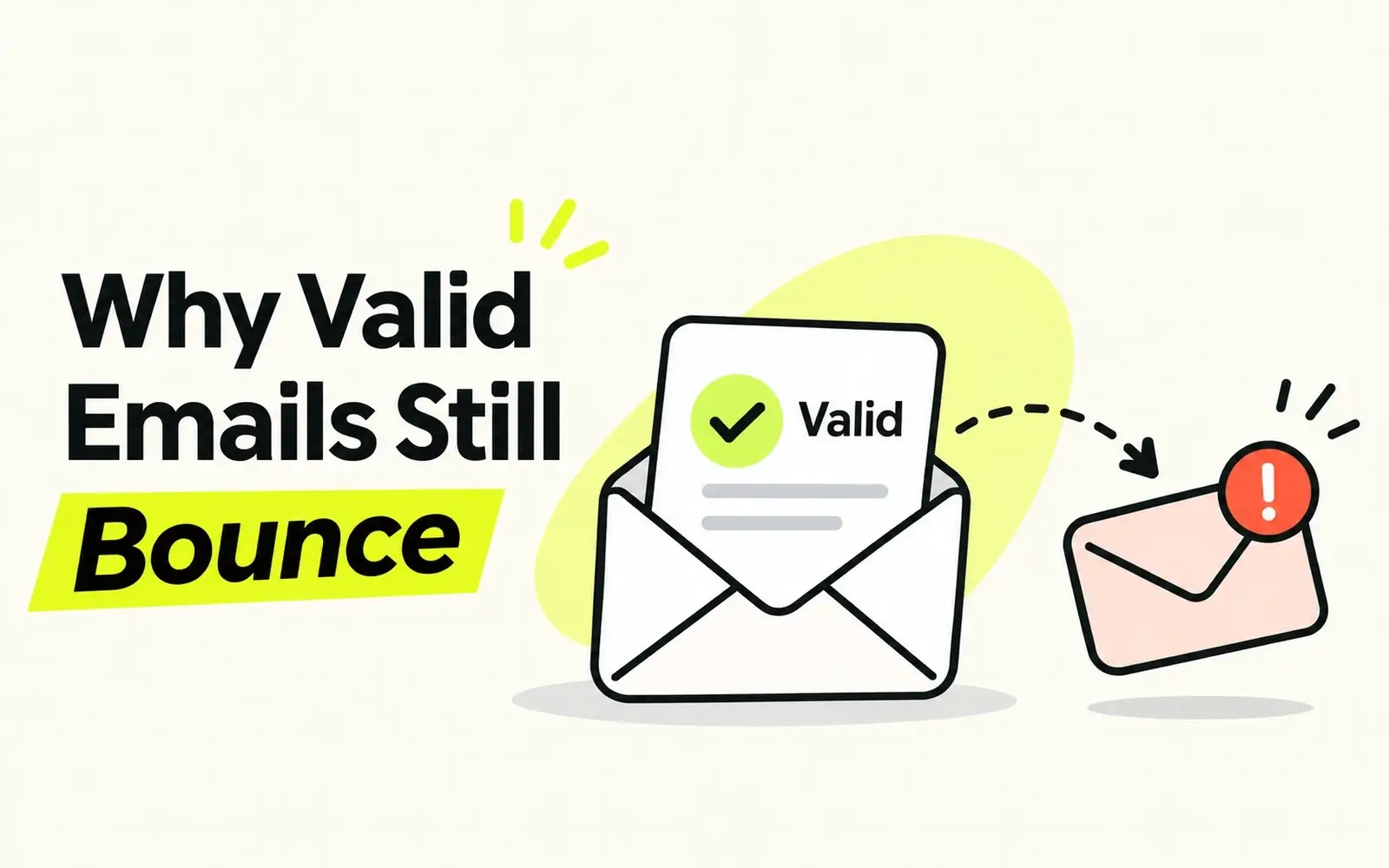
Why SMTP Acceptance Does Not Guarantee Deliverability
Even when a server accepts an address, several things can happen afterward.
The message might reach a real mailbox. It might be filtered or quarantined. It might be rejected later, silently discarded, or otherwise fail to reach the intended recipient.
In addition, an existing mailbox does not guarantee inbox placement.
Spam filtering, sender reputation, authentication, message content, and organizational policies can all affect delivery.
Email verification estimates address validity and delivery risk. It does not guarantee successful delivery or inbox placement.
This distinction matters especially when evaluating catch-all email addresses.
Valid, Invalid, Risky, and Unknown: What Do They Mean?
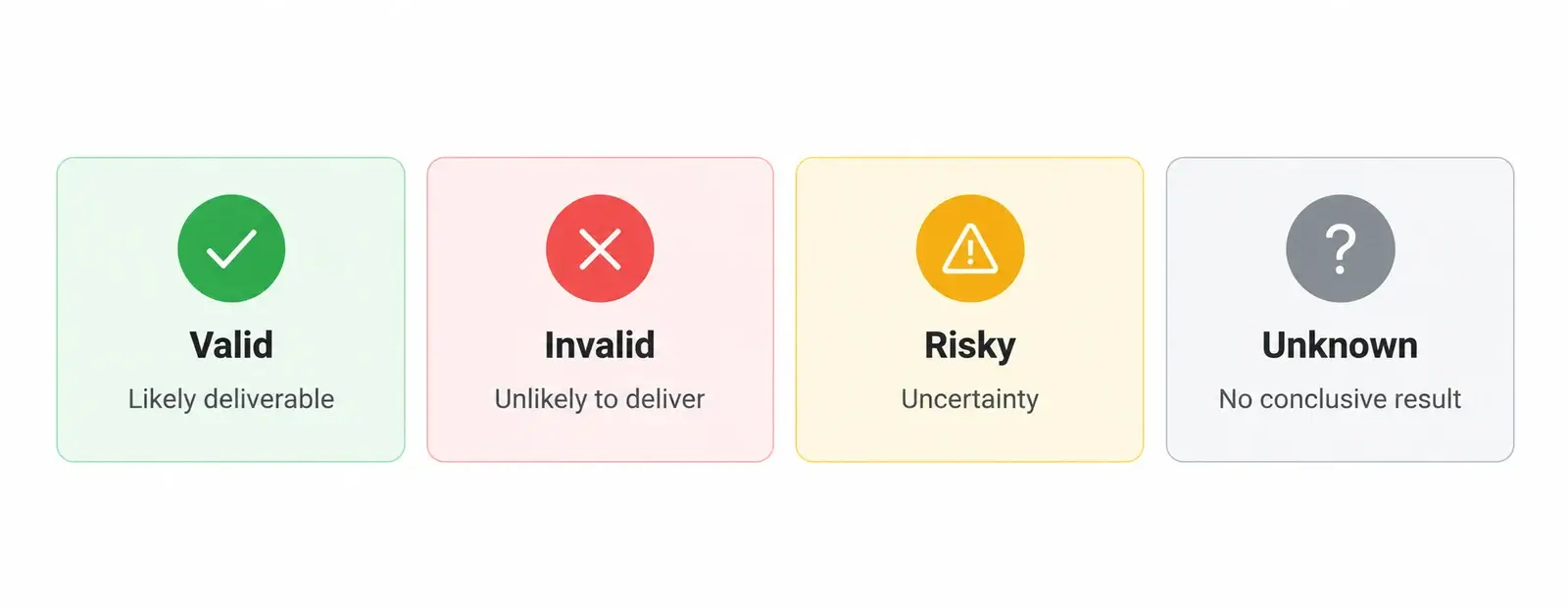
Email verification tools typically classify addresses into categories that describe the available evidence and potential delivery risk.
Understanding these categories helps businesses avoid treating every uncertain address as invalid.
Status | Meaning | Recommended Interpretation |
|---|---|---|
Valid / Verified | Available signals indicate that the address is likely deliverable. | Higher confidence, but delivery is not guaranteed. |
Invalid | Verification indicates that the address is unlikely to receive email. | Generally exclude from sending. |
Risky | The address has unresolved delivery risk, potentially including catch-all behavior. | Evaluate further before sending. |
Unknown | The verification process could not reach a conclusive result. | Retry or investigate using additional signals. |
Why Catch-all Emails Are Often Classified as Risky
When a server accepts multiple recipient addresses without confirming individual mailboxes, the verification tool cannot reliably determine which addresses are genuine.
Instead of labeling every address Valid, the system may classify them as Risky. Understanding email accuracy for cold outreach is essential when deciding how to handle risky and uncertain business email addresses.
This is a cautious response to insufficient evidence.
However, Risky does not automatically mean catch-all. Other factors can also create uncertainty.
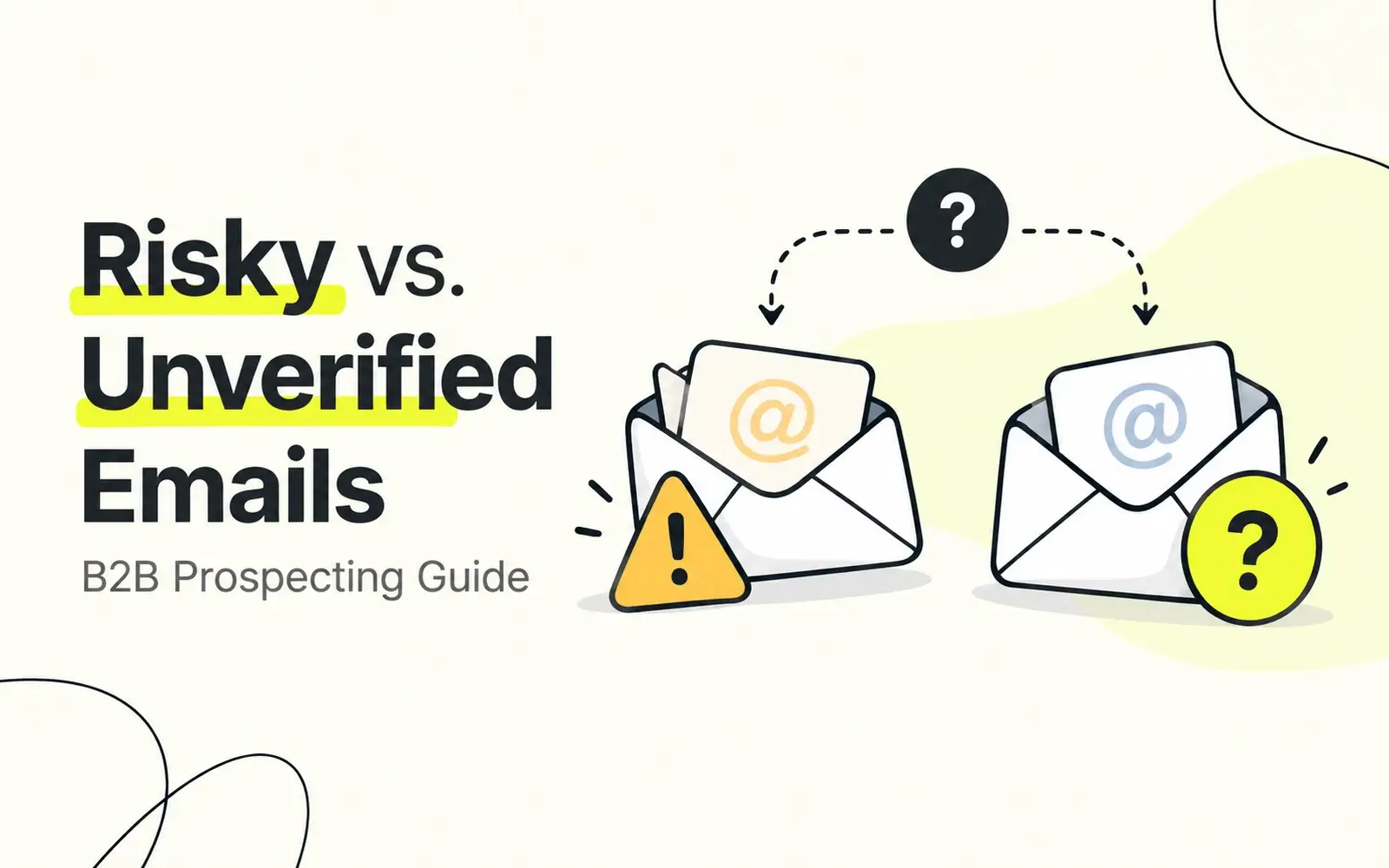
Risky vs. Unknown: What's the Difference?
A Risky classification generally indicates that the tool identified a specific source of uncertainty or delivery risk.
An Unknown classification indicates that the available verification process did not produce enough evidence for a reliable conclusion.
The exact definitions vary across providers.
Neither category should automatically be interpreted as proof that an address is invalid.
For B2B prospecting teams, these distinctions are important because potentially valuable contacts can remain hidden inside uncertain classifications.
Why Catch-all Emails Matter for B2B Prospecting
Catch-all verification is more than a technical issue. It directly affects the size, quality, and usefulness of B2B contact databases.
Consider a prospecting team working with 10,000 business email addresses.
If 40% belong to catch-all domains, the team may have 4,000 addresses whose mailbox existence cannot be confidently established through conventional SMTP verification alone.
This is an illustrative scenario, not a universal industry distribution.
The team faces two difficult options.
Option One: Send to Every Catch-all Address
Sending without proper email verification may expose the campaign to avoidable bounces and other delivery risks.
High bounce rates can reduce campaign efficiency and may contribute to sender-reputation problems.
A larger list does not necessarily produce better outreach results if the underlying email data is unreliable.
Option Two: Exclude Every Catch-all Address
Automatically removing all catch-all addresses can also be costly.
Some of those addresses may belong to real employees, executives, purchasing managers, or other valuable decision-makers.
Excluding them reduces the number of potentially reachable prospects and can limit market coverage.
The Better Approach: Verify Before Sending
The goal should not be to send to every catch-all address or discard every uncertain contact.
Instead, businesses need reliable email verification that can identify valid business email addresses, including those associated with catch-all domains.
AI-powered email verification helps resolve cases that traditional SMTP checks leave uncertain, enabling teams to prioritize verified contacts rather than relying on unverified email lists.
This is where Kitmind's AI-powered email verification technology becomes especially valuable.
How Kitmind AI Goes Beyond Traditional Catch-all Email Verification
Traditional SMTP verification is an important foundation for email validation, but it cannot always determine whether a catch-all address belongs to a real mailbox.
Kitmind's AI-powered verification system is designed to go beyond that limitation.
Rather than treating inconclusive SMTP responses as final results, Kitmind applies its AI-powered email verification algorithms to verify business email addresses that traditional methods leave as Risky or Unknown.
1. The Limits of SMTP-only Verification
A conventional verification workflow may identify valid and invalid addresses relatively easily when receiving servers provide clear responses.
However, when a catch-all domain accepts unknown recipients, the verifier may have insufficient evidence to make a reliable mailbox-level decision.
That leaves potentially legitimate contacts classified as Risky or Unknown.
For B2B teams, these unresolved classifications can represent a significant amount of lost prospecting opportunity.
2. Kitmind's Two-Stage Verification Approach
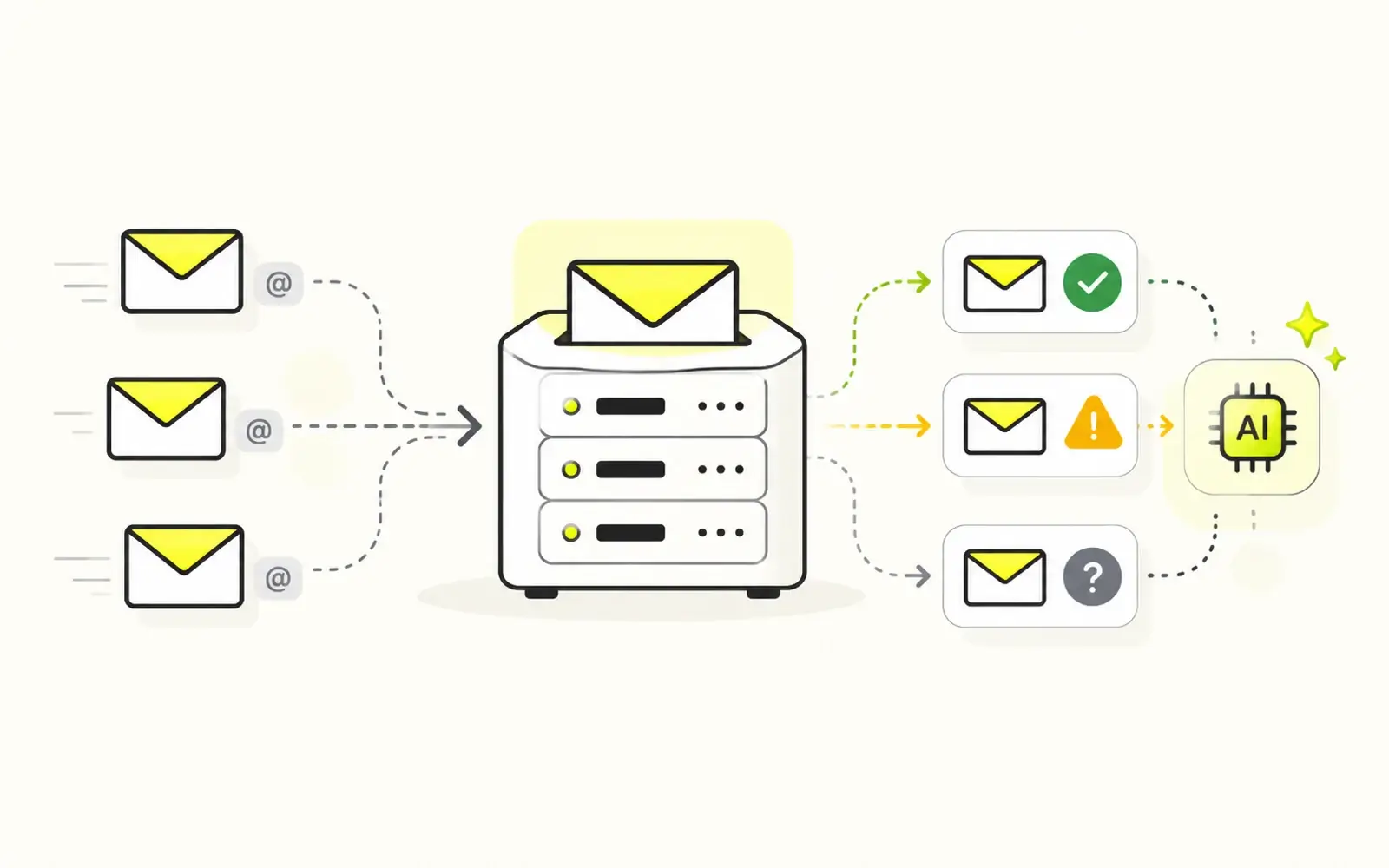
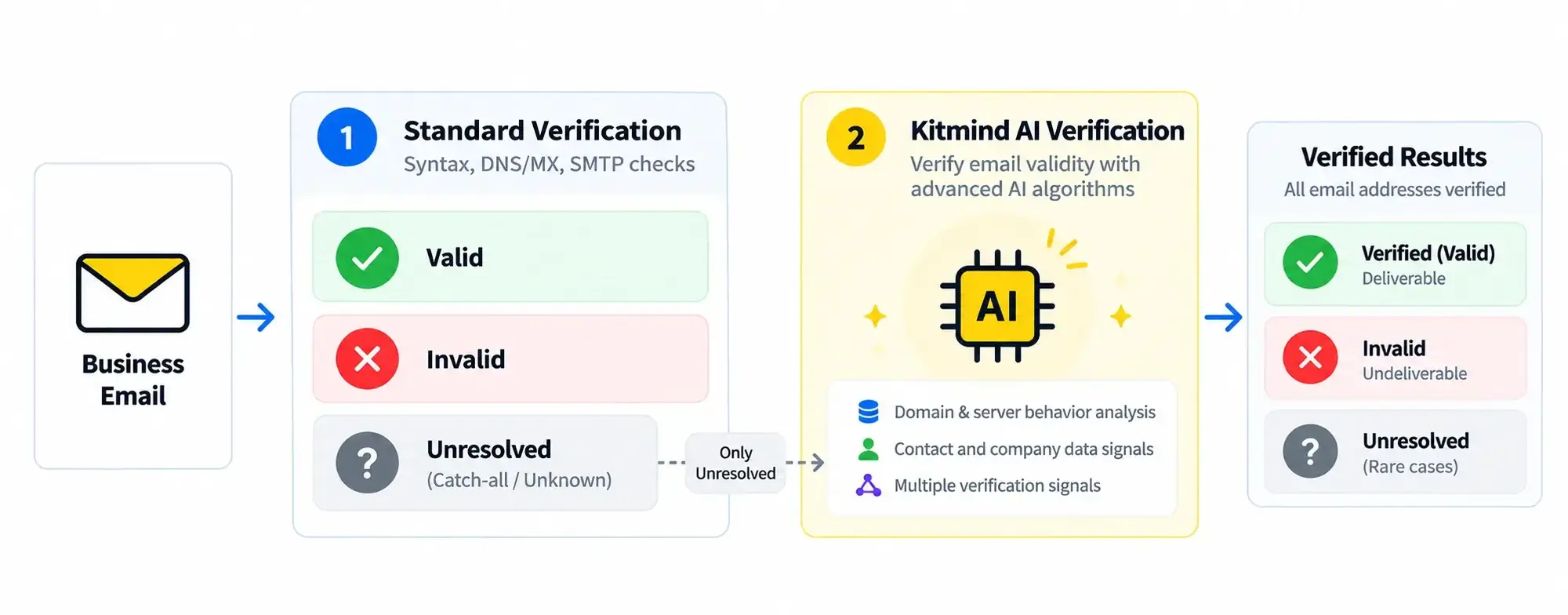
Kitmind uses a two-stage approach to address this problem.
Stage 1: Standard Email Verification
The system first evaluates the email address using conventional verification checks, including address structure, domain information, mail-routing signals, and available server responses.
Addresses that can be classified with sufficient confidence receive an appropriate result.
Addresses that remain unresolved after standard verification proceed to Kitmind's AI-powered verification stage.
Stage 2: AI-powered Email Verification
Kitmind applies its AI-powered verification algorithms to verify email addresses that remain unresolved after conventional checks, including catch-all and traditionally Unknown emails.
This additional verification stage enables Kitmind to identify valid business email addresses beyond the limitations of conventional SMTP verification.
Contacts with verified valid email addresses are available through the Verified email status in Kitmind Prospector, including contacts using catch-all email domains.
AI-powered email verification establishes email validity using Kitmind's verification algorithms. However, even a verified email address does not guarantee inbox placement, which also depends on sender reputation, authentication, filtering policies, and other delivery factors.
3. Moving Beyond the Risky Classification
Traditional verification systems may stop when an address is classified as Risky.
Kitmind uses AI-powered email verification to resolve catch-all addresses that traditional SMTP-based tools would otherwise leave classified as Risky.
Kitmind verifies email validity using additional verification signals, allowing contacts with valid email addresses to be identified through the Verified filter.
This helps sales and marketing teams prioritize contacts that would otherwise remain in an uncertain category.
4. Handling Unknown Email Addresses
Unknown results can arise from server restrictions, temporary technical conditions, or insufficient verification evidence.
Kitmind's AI-powered email verification technology also addresses email addresses that conventional verification tools classify as Unknown.
Instead of leaving these contacts unresolved, Kitmind applies its AI verification algorithms to determine email validity and identify verified business email addresses.
In Kitmind Prospector, users can simply select Email Status → Verified to find contacts with verified valid email addresses, without manually reviewing traditional Risky or Unknown classifications.
This helps B2B teams build more reliable prospecting lists while maintaining access to valuable contacts that conventional verification methods may overlook.
5. Why This Matters for B2B Teams
The value of Kitmind AI email verification lies in identifying verified valid business email addresses that conventional SMTP-based tools may leave as Risky or Unknown.
By combining AI-powered verification with B2B contact discovery, Kitmind enables users to find verified contacts directly through Prospector, without a separate manual verification workflow.
For example, a sales team can use Kitmind Prospector's Verified email filter to discover valid business contacts, including verified catch-all email addresses that traditional tools might leave unresolved.
A marketing team may be able to reduce unnecessary exclusions while maintaining a more disciplined approach to delivery risk.
For revenue teams, the practical benefit is a better balance between contact coverage and email-data quality.
Kitmind AI Catch-all Verification: Coverage and Accuracy
Kitmind reports two important performance figures for its AI-powered catch-all verification system.
Approximately 99% Catch-all Verification Coverage
According to Kitmind's internal performance data, its AI-powered verification technology achieves approximately 99% verification coverage for catch-all email cases.
This metric describes the proportion of catch-all cases covered by Kitmind's verification process, based on its internal testing methodology.
It does not mean that 99% of catch-all addresses are valid, nor does it mean that 99% of messages will be delivered.
Over 96% Verification Accuracy
Kitmind reports over 98% verification accuracy for catch-all email addresses based on its internal testing data.
Verification accuracy describes how closely the system's classifications match the reference outcomes used in evaluation.
It is different from inbox-placement rate, sending success rate, and the percentage of addresses classified as valid.
To evaluate this metric fully, readers should understand the test sample, reference-label methodology, and how unresolved cases were handled.
Traditional Verification vs. Kitmind AI
The key difference is Kitmind's ability to verify business email addresses beyond conventional SMTP limitations, including catch-all and traditionally Unknown emails.
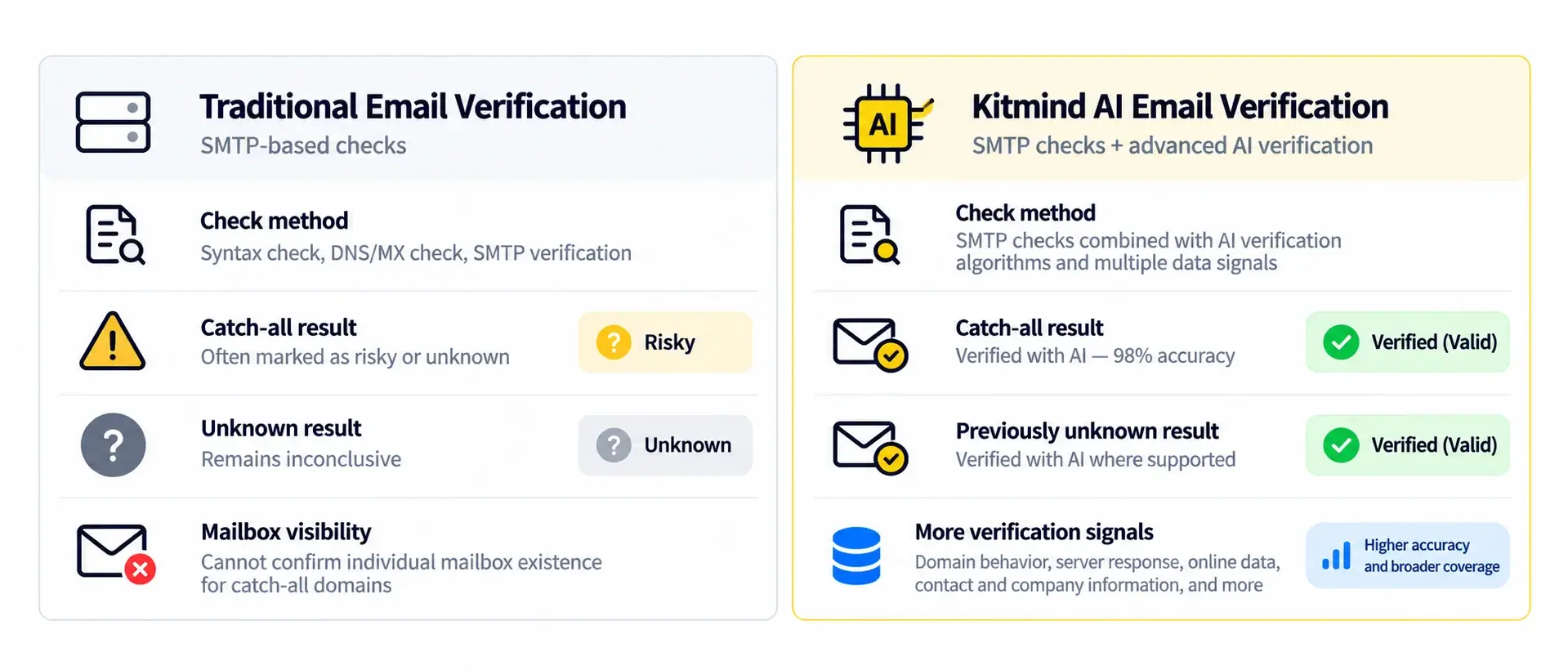
Capability | Traditional SMTP Verification | Kitmind AI-assisted Verification |
|---|---|---|
Syntax and domain checks | Supported | Supported |
SMTP response evaluation | Supported | Supported |
Catch-all uncertainty | Often remains unresolved | Additional AI verification |
Risky email classification | May remain Risky | May receive a more specific verification |
Unknown results | Often inconclusive | Additional evaluation where supported |
Guaranteed inbox delivery | No | No |
Kitmind extends traditional email verification with AI-powered algorithms that verify business email addresses, including catch-all and traditionally Unknown cases.
Its reported verification coverage and accuracy figures are based on internal performance data rather than independently audited industry-wide comparisons.
For B2B teams, the practical benefit is straightforward: discover more verified business contacts through Kitmind Prospector and filter for verified valid emails before outreach.
How to Handle Catch-all Emails in B2B Outreach
Even with advanced verification technology, effective outreach requires a disciplined approach to email-data quality.
Here are five practical steps.
Five Steps for Handling Catch-all Emails
1
Find Verified Business Contacts
Start with Kitmind Prospector to discover B2B contacts with verified business email addresses.
2
Filter for Verified Catch-all Emails
Kitmind's AI-powered verification technology verifies catch-all email addresses beyond traditional SMTP limitations.
3
Build Outreach Lists with Verified Contacts
Build your outreach lists using contacts filtered by Verified email status in Kitmind Prospector.
4
Maintain Contact Data Regularly
Business email data changes. Employees leave companies, organizations migrate mail systems, and previously valid addresses become inactive. Regularly updating contact records and re-verifying older email addresses can help reduce avoidable errors.
5
Monitor Actual Sending Results
Verification should be part of an ongoing data-quality process. Monitor hard bounces, temporary delivery failures, and other relevant campaign signals. A verified address may still bounce because of conditions that change after verification. Use actual sending outcomes to improve list maintenance and future prospecting decisions.
The best strategy combines reliable contact discovery, intelligent verification, and continuous data maintenance.
The Future of Catch-all Email Verification
Catch-all email verification will continue to be challenging as organizations adopt more sophisticated mail-routing, privacy, and anti-abuse systems.
Traditional SMTP verification remains useful, but it is not sufficient for every domain or recipient.
The future of verification lies in combining established technical checks with additional evidence and carefully evaluated predictive models.
AI-powered verification can extend email validity checks beyond traditional SMTP limitations, while verification accuracy should continue to be measured against reliable reference outcomes.
For B2B teams, the goal is not perfect certainty in every case.
It is to make more accurate, better-informed decisions about which contacts are worth pursuing.
Final Takeaways
Catch-all email addresses create a fundamental challenge for conventional email verification because a server can accept a recipient without confirming that the individual mailbox exists.
This uncertainty can leave potentially valuable B2B contacts classified as Risky or Unknown.
Automatically sending to every uncertain address introduces unnecessary risk. Automatically discarding them may eliminate legitimate business opportunities.
AI-powered email verification offers a more effective approach by verifying business email addresses that traditional SMTP checks leave unresolved, including catch-all and Unknown cases.
Kitmind's AI-powered email verification system goes beyond SMTP-only limitations to identify verified valid business email addresses, helping B2B teams discover more contacts through Prospector.
The result is a more balanced approach to prospecting—one that prioritizes both contact coverage and data quality.
Frequently Asked Questions
What is a catch-all email address?
A catch-all email address belongs to a domain whose mail infrastructure may accept messages for recipients without confirming whether each individual mailbox exists.
Can catch-all emails be verified?
Yes. Catch-all emails can be verified using advanced AI-powered email verification technology. While traditional SMTP checks often cannot confirm whether an individual catch-all mailbox exists, Kitmind uses AI verification algorithms to verify email validity beyond these limitations. Users can find verified catch-all contacts directly in Kitmind Prospector.
Are catch-all emails safe to send to?
Not automatically. Some catch-all addresses belong to genuine recipients, while others may be nonexistent or undeliverable. Additional verification and careful sending practices are recommended.
Why are catch-all emails marked Risky?
Catch-all behavior can prevent conventional SMTP verification from determining whether a specific mailbox exists. Tools may therefore classify the address as Risky rather than Valid or Invalid.
What is the difference between Risky and Unknown emails?
Risky generally indicates identifiable uncertainty or delivery risk, while Unknown means the verification process did not reach a conclusive result. Exact definitions depend on the provider.
How does AI help verify catch-all emails?
AI-powered email verification uses additional verification signals and algorithms to determine email validity beyond conventional SMTP responses. Kitmind applies this technology to verify catch-all and traditionally Unknown email addresses, enabling users to discover verified business contacts through the Prospector Verified filter. Verification confirms email validity according to the system's checks, but does not guarantee inbox delivery.
Does a verified catch-all email guarantee inbox delivery?
No. Verification assesses address validity or delivery risk. Inbox placement also depends on sender reputation, authentication, content, filtering policies, and other factors.