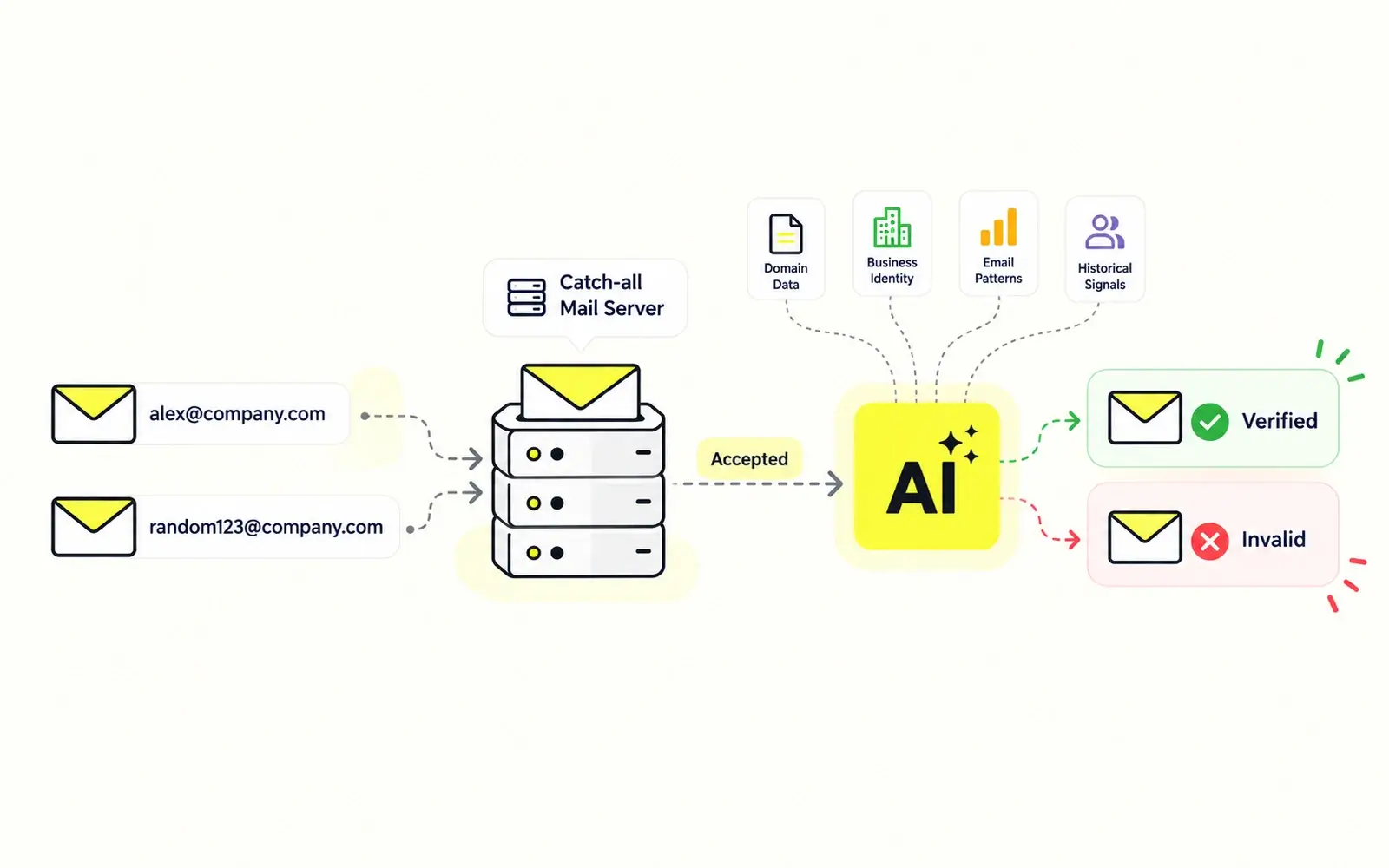
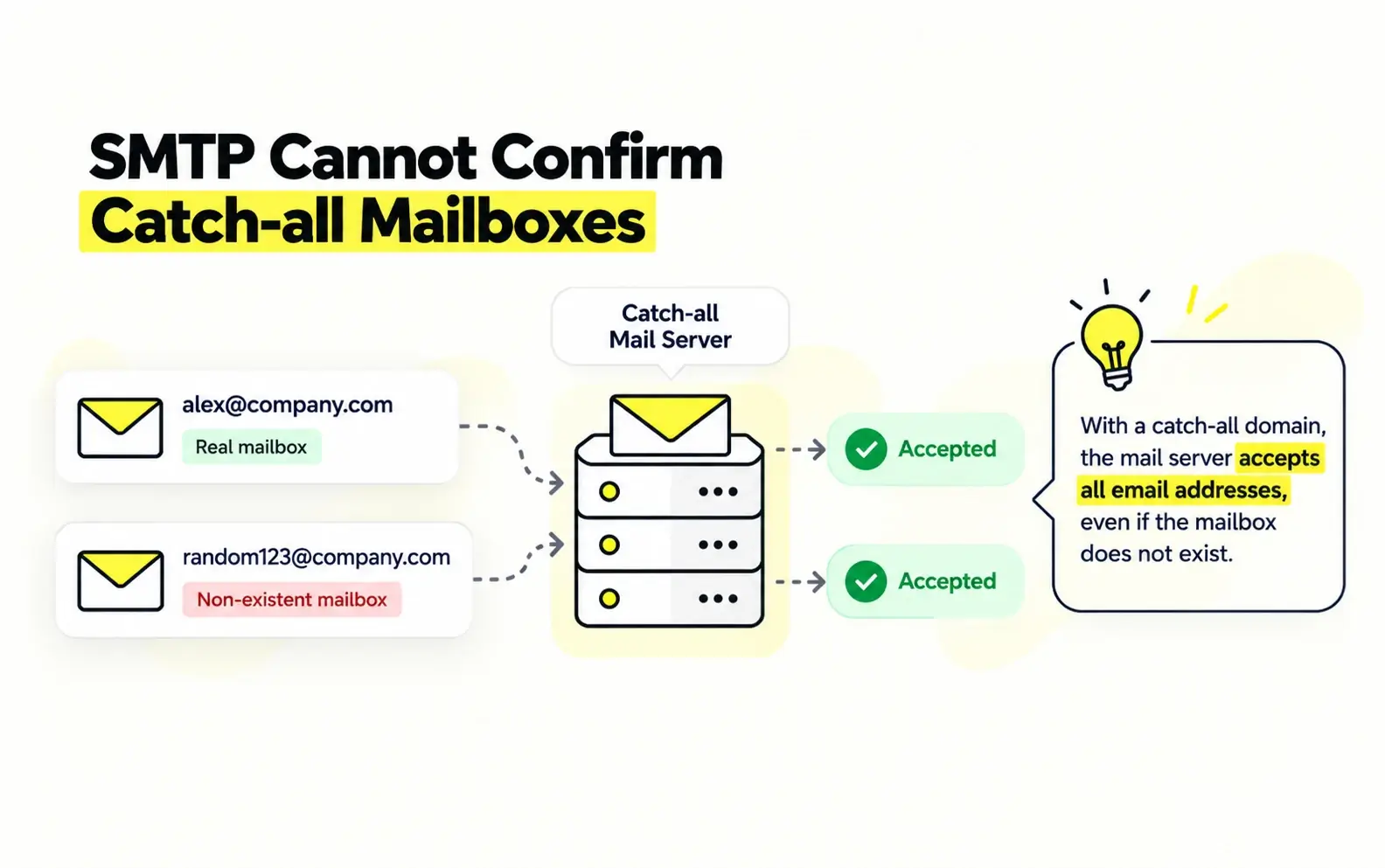
Imagine verifying two business email addresses: alex@company.com, which belongs to an active employee, and random123@company.com, which does not exist.
A traditional SMTP check contacts the company's mail server. Surprisingly, both addresses receive an accepted response.
Does that mean both emails are valid? Not necessarily.
The domain may use a catch-all email configuration, which accepts messages addressed to both existing and unknown recipients. For conventional email verification tools, this creates a problem: an accepted SMTP response cannot reliably confirm whether an individual mailbox exists.
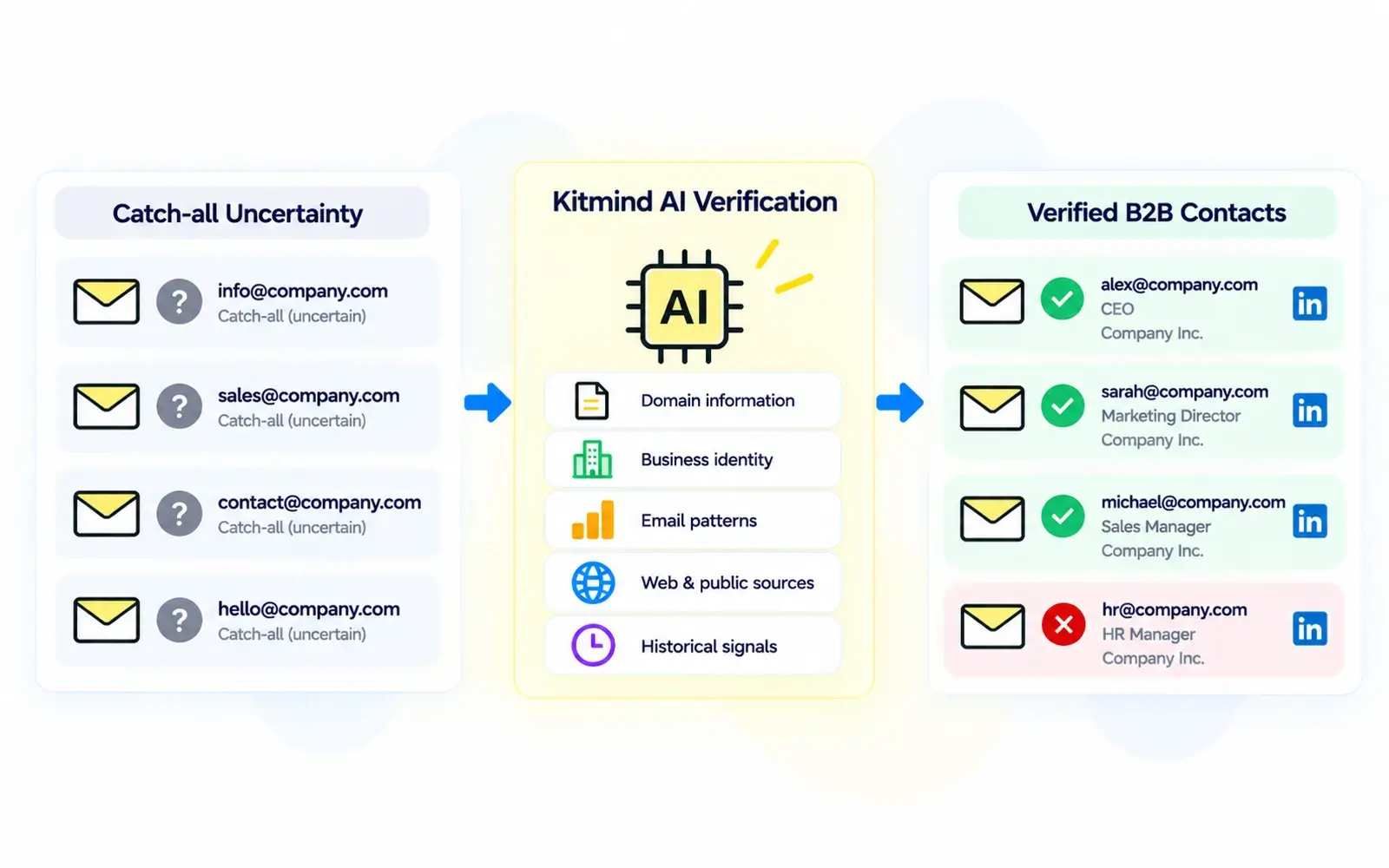
AI-powered catch-all email verification offers a more advanced approach. By evaluating additional technical, contextual, and data-driven signals, AI can help assess addresses that traditional SMTP checks leave uncertain.
This article explains why traditional SMTP checks struggle with catch-all emails, how AI-assisted verification evaluates additional evidence, and where its limitations remain. You'll also learn how Kitmind integrates AI-powered catch-all verification into its global B2B data platform, helping GTM teams discover relevant companies and decision-makers while accessing pre-verified business emails.
Key Takeaways
Traditional SMTP checks struggle with catch-all domains. Mail servers may accept both real and nonexistent addresses, making mailbox-level verification inconclusive.
AI can improve verification through multiple signals. Domain information, business identity, email patterns, and historical observations can provide additional evidence beyond SMTP responses.
Kitmind integrates AI-powered catch-all verification into B2B prospecting. With a stated 98%+ catch-all verification accuracy, Kitmind helps GTM teams access verified business emails through company-first discovery and contact-first prospecting.
Better verification supports more reliable outreach decisions. By combining verified email data with relevant company and professional information, B2B teams can identify decision-makers, reduce avoidable uncertainty, and build higher-quality prospect lists.
Why Traditional SMTP Verification Struggles with Catch-all Emails
How SMTP Verification Works
SMTP (Simple Mail Transfer Protocol) is used to transfer emails between mail servers.
During a conventional verification attempt, a system may connect to the receiving server and check how it responds to a proposed recipient using commands such as RCPT TO.
The server may accept the address, reject it, or return an inconclusive response.
A rejection can provide useful evidence that an address is invalid. However, acceptance does not necessarily prove that the mailbox exists.
Mail servers may deliberately conceal recipient information to limit abuse or unwanted address enumeration.
The Catch-all Problem
A catch-all domain may accept messages addressed to nonexistent recipients rather than rejecting them immediately.
Consider the following example:
Email Address | Actual Status | SMTP Response |
|---|---|---|
| Existing mailbox | Accepted |
| Active shared mailbox | Accepted |
| Nonexistent mailbox | Accepted |
| Nonexistent mailbox | Accepted |
Illustrative example; actual server behavior varies.
All four addresses receive the same initial response, even though only two correspond to existing mailboxes.
This creates two risks:
- False positives: Nonexistent addresses are incorrectly classified as valid.
- Lost opportunities: Legitimate contacts are excluded because their domains cannot be verified through conventional SMTP checks.
For B2B teams, neither outcome is desirable.
SMTP Acceptance Is Not Delivery Confirmation
Even after accepting an address, a mail server may reject the message later, apply additional filtering, or route it to an unexpected destination.
SMTP verification therefore provides technical evidence, not a delivery guarantee.
To understand these configurations in more detail, learn what a catch-all email is and how catch-all domains handle incoming messages.
What AI Changes in Catch-all Email Verification
Traditional SMTP checks focus primarily on the receiving server's response.
AI-assisted verification can evaluate a broader range of evidence to determine whether an address is likely to represent a usable business mailbox.
The difference is the question being asked.
Traditional SMTP: Did the server accept this recipient?
AI-assisted verification: Based on the available evidence, how confident can we be that this address is usable?
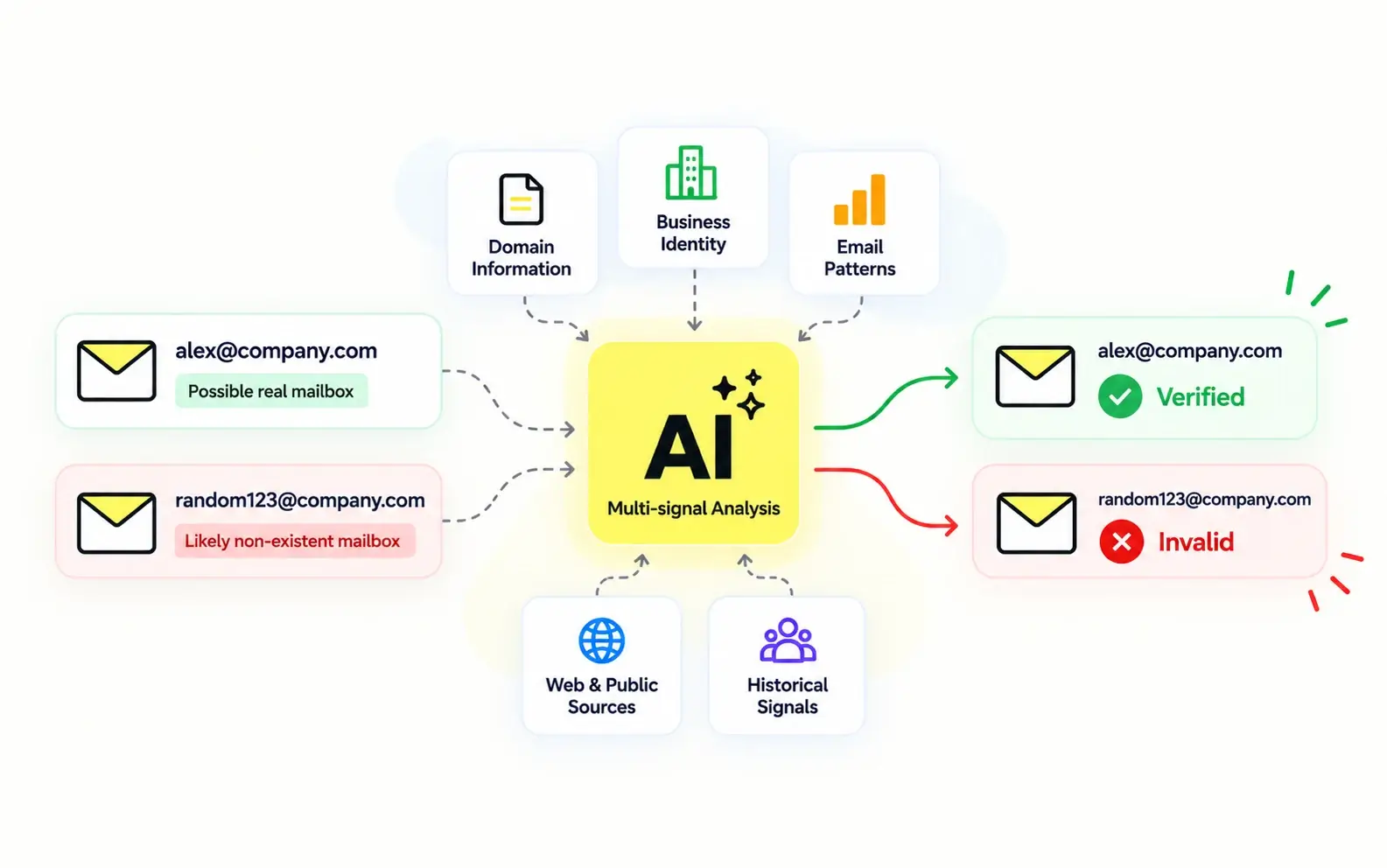
Rather than relying on one response, an AI-assisted system can analyze relationships among technical information, business identity, email patterns, and other available signals.
For example, an address associated with a known employee and consistent with a company's established email convention may have stronger supporting evidence than an arbitrary address on the same catch-all domain.
Neither observation proves mailbox existence on its own. Together, however, they may support a more informed assessment.
This is the central advantage of multi-signal verification: improving the interpretation of uncertain results without assuming that every accepted address is valid.
For a broader comparison of verification techniques, see our guide to traditional email verification methods.
The Signals AI Can Use to Assess Catch-all Emails
AI-assisted catch-all verification can draw on multiple categories of technical, contextual, and observational evidence. The following examples illustrate general approaches used in email verification; they do not describe or disclose Kitmind's proprietary AI models, data sources, or internal verification processes. These examples represent only a fraction of Kitmind's AI verification capabilities.
Domain and Mail Infrastructure
DNS records, MX configuration, mail providers, and server behavior can help establish whether a domain has functioning email infrastructure.
These checks provide useful context, but they cannot independently confirm an individual mailbox on a catch-all domain.
Business Identity and Email Patterns
Business contact information can help assess whether an email address is consistent with a person's organization and the company's known naming conventions.
For example, if a company commonly uses firstname.lastname@company.com, an address following that format may be plausible.
However, a plausible email pattern is not proof of validity. Employees may use aliases, alternative domains, or different address formats.
Historical and Observational Data
Historical observations may provide additional evidence about an address or domain.
Nevertheless, email information changes. Employees leave companies, accounts are disabled, and mail systems are updated.
Data freshness is therefore essential when evaluating historical signals.
Cross-Signal Consistency
The greatest value often comes from analyzing how different signals relate to one another.
- Address A: Matches a known employee, follows the company's email convention, and has consistent supporting evidence.
- Address B: Has no identifiable employee association and limited supporting evidence.
Both may receive identical SMTP responses, yet their available evidence differs significantly.
AI-assisted systems can potentially use these differences to improve verification decisions.
How AI-Assisted Catch-all Verification Works
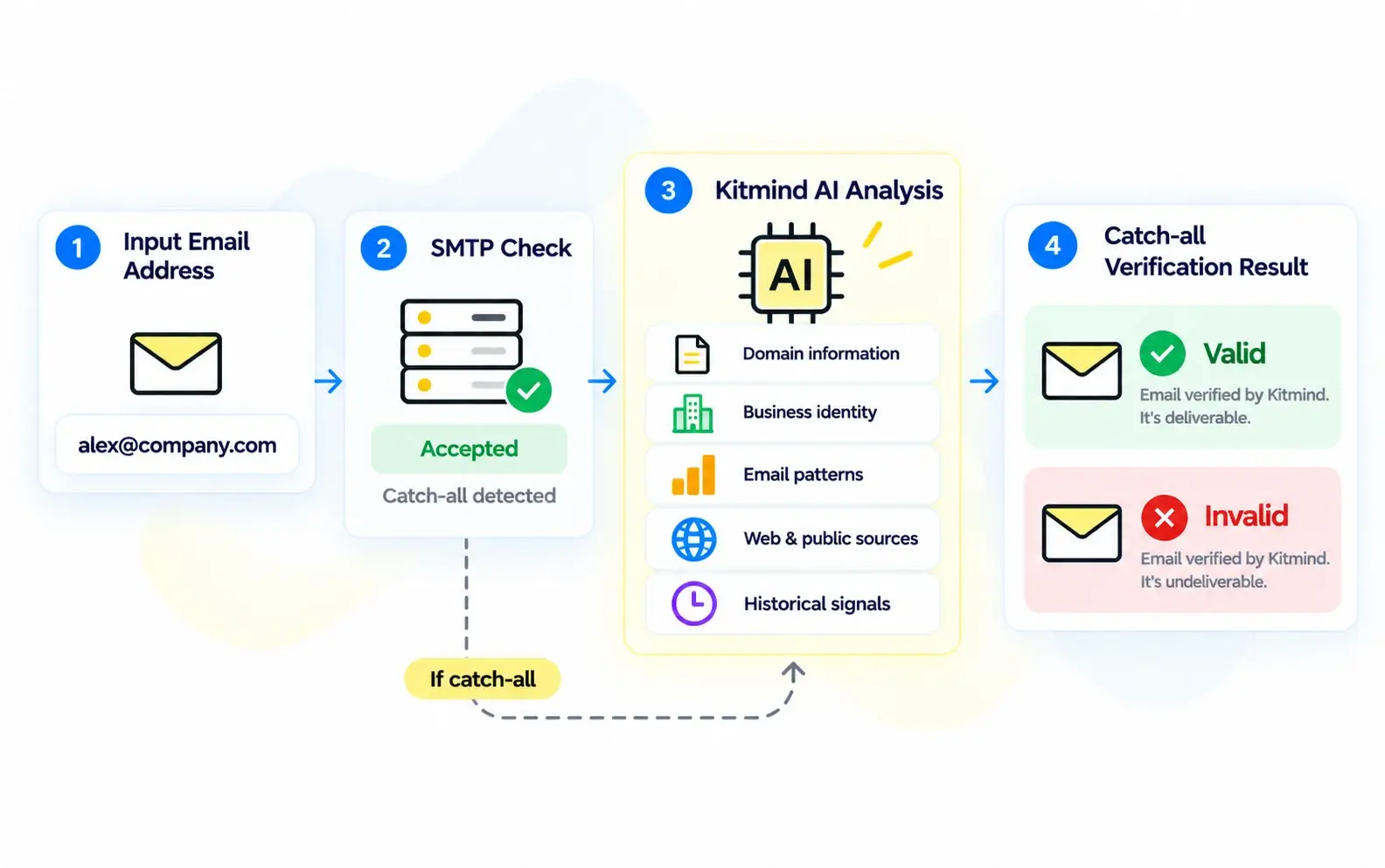
Although verification providers use different technologies, the general process can be understood through four stages.
Step 1: Detect Catch-all Behavior
The system examines the domain and relevant server responses to identify whether arbitrary recipient addresses appear to be accepted.
If catch-all behavior is detected, SMTP acceptance alone cannot establish mailbox validity.
Step 2: Collect Additional Evidence
The system gathers available supporting signals, which may include domain information, business identity, email conventions, and historical observations.
The quality and freshness of this information directly affect its usefulness.
Step 3: Evaluate Signals Together
AI-assisted analysis can examine relationships between the collected signals, identify inconsistencies, and estimate the strength of available evidence.
Rather than applying a single rigid rule, the system can make a more nuanced assessment.
Step 4: Produce a Verification Result
Based on the available evidence, the system produces a verification result.
Different providers may use different result categories. In Kitmind's AI-powered catch-all verification workflow, email addresses are classified as Valid or Invalid, reflecting the system's assessment of their validity.
These classifications do not guarantee future email delivery or inbox placement. While AI can improve verification accuracy, it cannot eliminate uncertainty entirely.
AI Email Verification vs. Traditional SMTP Checks
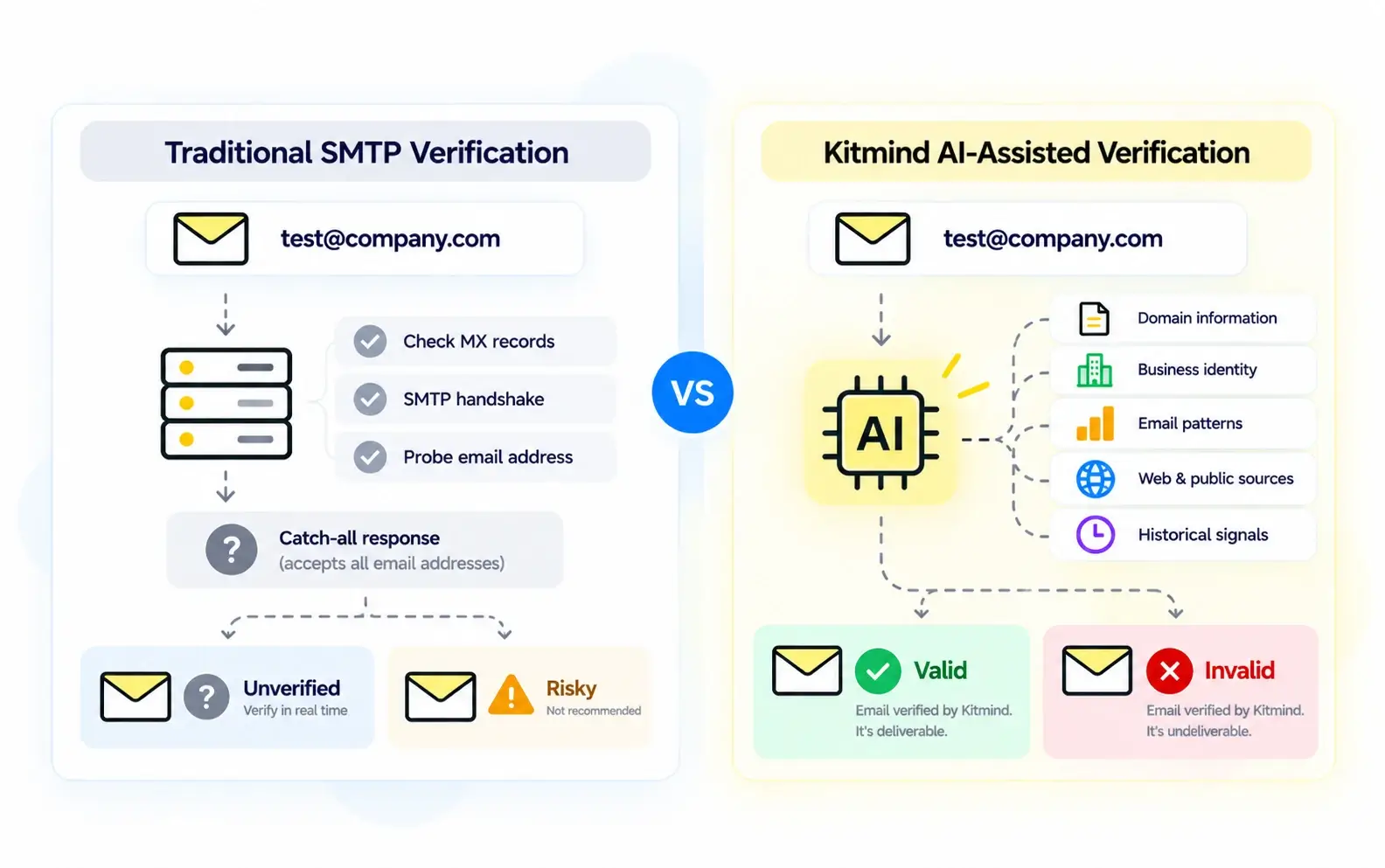
Both approaches can contribute to email verification, but they differ in how they handle uncertainty.
Comparison | Traditional SMTP | AI-Assisted Verification |
|---|---|---|
Main approach | Server responses | Multiple verification signals |
Catch-all handling | Often inconclusive | May improve confidence |
Business identity | Generally not considered | May provide supporting evidence |
Historical context | Not inherent to basic checks | May incorporate observations |
Traditional SMTP remains useful, particularly when a server provides a clear rejection.
AI-assisted verification becomes especially valuable when SMTP responses alone cannot distinguish between legitimate and nonexistent recipients.
However, an AI label does not automatically make a verification service more accurate. Performance must be supported by appropriate testing.
How Accurate Is AI Catch-all Email Verification?
AI-assisted verification can improve the assessment of catch-all addresses, but accuracy should be evaluated carefully.
Understanding Verification Accuracy
When assessing an accuracy claim, consider how the provider defines a correct result, whether uncertain addresses are included, and how actual outcomes were established.
Testing conditions, domain diversity, and data freshness can all influence reported performance.
Two error types are particularly important:
- False positive: An unusable email is incorrectly classified as valid.
- False negative: A usable email is incorrectly classified as invalid.
False positives can increase outreach risk, while false negatives may cause businesses to miss legitimate contacts.
A useful verification system should balance these risks rather than simply maximize the number of addresses classified as valid.
Why Verification Cannot Guarantee Delivery
Even a verified mailbox can become unavailable after verification.
Delivery also depends on recipient filtering, sender authentication, sender reputation, and message content.
Therefore, verification accuracy, delivery rate, and inbox placement are separate measures.
A verified address improves confidence in recipient data; it does not guarantee that every future message will reach the inbox.
How Kitmind Uses AI-Powered Catch-all Verification
Kitmind integrates AI-powered email verification into its global B2B lead intelligence platform, helping sales, marketing, and growth teams discover relevant companies, identify decision-makers, and access verified business email addresses.
Catch-all domains present a particular challenge because traditional SMTP checks may accept both existing and nonexistent email addresses. Kitmind's AI-powered verification technology helps address this uncertainty, making verified business email data available within its prospecting workflows.
98%+ Catch-all Verification Accuracy
Kitmind's AI-powered catch-all email verification achieves 98%+ accuracy, helping distinguish valid and invalid business email addresses that traditional SMTP checks may struggle to assess.
This accuracy figure specifically applies to catch-all email verification. It does not represent a guaranteed email delivery rate, inbox placement rate, or the accuracy of every record in the database.
The value extends beyond identifying potentially valid addresses. By improving verification decisions for catch-all domains, Kitmind helps businesses access relevant contacts that conventional SMTP-only approaches might otherwise leave uncertain or exclude.
Kitmind's specific AI algorithms and verification methods are proprietary. The broader principles discussed in this article illustrate how AI-assisted verification can use multiple signals; they should not be interpreted as a disclosure of Kitmind's internal technology.
Learn more about Kitmind's data coverage and accuracy.
AI-Verified Business Emails Built Into B2B Prospecting
Kitmind incorporates verified business email data directly into two complementary prospecting workflows: company-first discovery and contact-first prospecting.
Kitmind Discover takes a company-first approach. B2B Teams can explore a global database of 85M+ companies, apply advanced filters to identify businesses that match their ideal customer profiles, research target organizations, and discover relevant employees. Once the right contacts are identified, users can reveal pre-verified business emails and save leads, export contact data, or sync records with connected CRM tools.
Kitmind Prospector takes a contact-first approach. It provides access to 300M+ professional profiles, including approximately 95M contacts with verified business emails. Sales and marketing teams can search for relevant professionals, refine results using contact-level filters, and reveal verified business emails for the decision-makers they want to reach.
Both workflows incorporate Kitmind's email verification capabilities, including AI-powered catch-all verification. Rather than requiring users to run a separate verification check for every revealed email address, Kitmind makes existing verification results available as part of the contact discovery experience.
Discover and Prospector can be used independently or together, depending on whether a team starts with target companies or individual decision-makers. Both support the same broader objective: turning relevant business intelligence into actionable prospecting opportunities.
What This Means for B2B Outreach
The practical benefit of AI-powered catch-all verification is not simply classifying more email addresses as valid. It is helping B2B teams make better decisions about which business contacts to include in their outreach.
Traditional SMTP checks can leave legitimate contacts unresolved, particularly when companies use catch-all domains. By incorporating AI-assisted verification into its B2B contact data, Kitmind helps reduce that uncertainty while preserving the distinction between email validity and actual message delivery.
Even a verified business email can become inactive, and successful delivery still depends on sender reputation, authentication, recipient filtering, and other factors.
For sales and marketing teams, the result is a more connected prospecting workflow: discover relevant companies or professionals, reveal verified business emails, and organize qualified contacts for outreach with greater confidence.
Why Better Catch-all Verification Matters for B2B Prospecting
Catch-all email verification affects more than email validity. It influences how B2B sales and marketing teams identify reachable prospects, evaluate contact quality, and prepare targeted outreach campaigns.
Reach More Relevant Decision-Makers
Automatically excluding every catch-all address can remove legitimate business contacts from valuable target accounts, limiting access to relevant decision-makers.
AI-assisted verification helps teams assess these otherwise uncertain addresses more effectively, potentially expanding the pool of usable business contacts without assuming that every catch-all address is valid.
For Kitmind users, this means greater confidence when identifying and revealing verified business emails for relevant professionals through Discover and Prospector.
Reduce Avoidable Outreach Risk
Sending emails to nonexistent or invalid addresses can increase bounce rates, waste outreach resources, and negatively affect sender reputation.
By improving the assessment of catch-all email addresses, AI-powered verification helps teams make more informed contact selection decisions and reduce avoidable sending risks.
However, verification is only one part of responsible outreach. Email authentication, list hygiene, sending practices, and recipient engagement also influence deliverability.
Build More Actionable Prospect Lists
Finding the right decision-makers is only part of B2B prospecting. Teams also need reliable contact information to turn research into actionable outreach opportunities.
Kitmind combines global company and professional data with AI-verified business emails, helping teams identify relevant prospects, reveal verified contact information, and organize leads for downstream sales and marketing activities.
For teams working with existing contact lists, Kitmind Data Enrichment can further improve data completeness by filling missing company and contact details.
Together, these capabilities help reduce fragmented research and support more efficient prospecting workflows—from identifying target businesses or professionals to preparing higher-quality contact lists.
Best Practices for Using AI-Verified Catch-all Emails
Even with advanced verification, reliable outreach depends on how contact data is maintained and used.
For additional guidance on building reliable outreach lists, explore email accuracy for cold outreach.
Prioritize verified business emails. Avoid relying solely on guessed email patterns or SMTP acceptance.
Keep contact data current. Mailboxes and employee relationships change over time, so older records should not be treated as permanently valid.
Confirm contact relevance. A functioning mailbox is only useful when it belongs to the intended person or business function.
Maintain responsible sending practices. Use appropriate authentication, relevant messaging, reasonable sending volumes, and applicable opt-out mechanisms.
Monitor bounce patterns. Unexpected changes may indicate outdated contact information or recipient-side delivery restrictions.
Evaluate provider claims carefully. Consider verification methodology, data freshness, uncertainty handling, and the scope of reported accuracy.
The objective is not simply to collect more email addresses. It is to build a reliable, relevant prospecting workflow.
Frequently Asked Questions
Can AI verify catch-all email addresses?
Yes. AI-assisted verification can assess catch-all email addresses using multiple signals beyond traditional SMTP checks. Kitmind's AI-powered catch-all verification achieves 98%+ accuracy, helping distinguish valid and invalid business email addresses that SMTP-only methods often struggle to verify. This technology is integrated into Kitmind's B2B prospecting platform, enabling teams to access verified business emails through Discover and Prospector. However, no verification method can guarantee future email delivery or inbox placement.
Why does SMTP verification fail on catch-all domains?
Catch-all servers may accept both existing and nonexistent recipient addresses. Consequently, a basic SMTP check may receive identical responses for addresses with different actual mailbox statuses.
How does AI improve catch-all verification accuracy?
AI can evaluate multiple signals, such as domain information, business identity, email patterns, and historical observations. Combining these signals may support a more reliable assessment than relying on a single SMTP response.
Can catch-all emails be verified without sending messages?
Verification systems can assess email addresses without sending a test message to the recipient. Methods may include DNS analysis, SMTP recipient checks, and additional data-driven techniques. However, the results can remain uncertain when servers conceal mailbox existence.
Does an AI-verified email guarantee delivery?
No. Verification assesses recipient-related evidence. Actual delivery depends on additional factors, including mailbox changes, filtering policies, sender reputation, and message content.
How does Kitmind help verify catch-all business emails?
Kitmind integrates AI-powered catch-all verification into its B2B contact data platform. Its verification technology supports access to pre-verified business emails through Discover and Prospector, helping teams identify relevant companies and decision-makers without treating email verification as a separate step. Kitmind states that its catch-all verification achieves 98%+ accuracy, although this does not guarantee email delivery or inbox placement.
Conclusion
Catch-all email verification highlights a fundamental limitation of traditional SMTP checks: server acceptance does not necessarily confirm mailbox existence.
AI-assisted verification can improve this process by evaluating additional evidence and making more informed assessments when SMTP results are inconclusive.
However, AI does not eliminate every verification risk. Accurate contact identity, current business information, and responsible sending practices remain essential.
For B2B teams, the real benefit of advanced verification is not simply identifying more addresses—it is improving confidence in the contact data used for prospecting.
Kitmind brings AI-powered catch-all verification together with company discovery and verified business email data, helping businesses find relevant prospects and connect with greater confidence.